To Do For All That Which No One Can Do For Oneself
Header

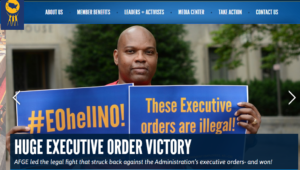
In a landmark decision, a federal judge has ruled that President Trump violated the U.S. Constitution and laws providing checks and balances in the federal government by attempting to deny more than 2 million federal workers their legal right to representation.

Judge Ketanji Brown Jackson of the U.S. District Court for the District of Columbia ruled late Friday that the Trump administration’s May 25 executive order on official time violated the U.S. Constitution and the separation of powers as established in law.

AFGE, which was the first union to challenge President Trump’s executive orders in court, applauded the judge’s ruling.  

“President Trump’s illegal action was a direct assault on the legal rights and protections that Congress specifically guaranteed to the public-sector employees across this country who keep our federal government running every single day,” AFGE President J. David Cox Sr. said.  

“We are heartened by the judge’s ruling and by the huge outpouring of support shown to federal workers by lawmakers from both parties, fellow union workers, and compassionate citizens across the country,” Cox added. “Our members go to work every single day to serve the American people, and they deserve all the rights and protections afforded to them by our founding fathers.” 


The lawsuits 

AFGE, the largest union representing federal government employees, filed two lawsuits challenging President Trump’s executive orders.  

The first lawsuit challenged the executive order on official time as a violation of the right to freedom of association guaranteed by the First Amendment, and as exceeding the president’s authority. The second lawsuit charged that the remaining two orders exceed the president’s authority under the U.S. Constitution by violating the separation of powers and exceeding current law.  

The impact of these executive orders began being felt months before they were even issued, as the Department of Education in March threw out the contract covering 3,900 federal employees represented by AFGE and implemented its own illegal management edict that strips workers of their union rights, a precursor to what was to come weeks later when President Trump issued the three union-busting, anti-federal worker executive orders.  

Since the executive orders were signed May 25, other agencies including the Social Security Administration and Department of Veterans Affairs have issued similar edicts in an attempt to eradicate unions from the federal workplace and deny workers their legal right to representation.  

“Now that the judge has issued her decision, I urge all agencies that have attempted to enforce this illegal executive order to restore all previously negotiated contracts and to bargain in good faith with employee representatives on any future changes as required under the law,” Cox said.  


 Union Busting Is a Threat to Our Democracy

Our union held a conference call with reporters July 12 to discuss the administration’s outrageous Executive Orders that seek to undermine America’s union and workforce.  

Union officials at the Social Security Administration and others are being stripped of access to vital tools that help us represent working people as we are required to do by law, including telephones, computers, Internet access, and even bulletin boards.  

Barri Sue Bryant, president of AFGE Local 2908 representing SSA employees in Philadelphia, told reporters that the Trump administration is making it nearly impossible to represent employees.  

“They told us yesterday that they won’t allow us to use leave without pay, or only in extremely limited conditions, to do representational duties,” she said.  

The executive orders have caused even more chaos at severely understaffed federal prisons, which have been struggling to respond to the influx of immigrant detainees.  

“Their attempts to silence us are creating nothing but chaos in the prison system,” said John Kostelnik, president of AFGE Local 3969 which represents Bureau of Prisons employees in Victorville, Calif.  

Undermining our democratic values  

The Trump administration has gone from being out of control to a serious threat to our democracy.  

While poll after poll has shown the American people overwhelmingly support labor unions, the weak Trump administration is being dictated by powerful special interests to do the dirty work for them. The Heritage Foundation, a fake think-tank funded by the likes of the Koch brothers, are openly pushing for policies that are bad for working people but good for businesses. A former Heritage employee now sits on Trump’s Domestic Policy Council and helps craft anti-worker policies like hiring freezes and retirement cuts.  

Our union exists to protect the merit systems, ensure justice, equality, and workers’ voice – all important factors for our government to serve and protect the American people. We make sure researchers, scientists, doctors, nurses, and other public servants have the tools and resources they need to do their jobs. But this administration is showing zero leadership in helping them do their jobs better.  

Red for Feds Day of Action 

Our union has filed lawsuits against the administration and has been joined by other unions and even members of Congress who are disgusted by this administration’s behavior.  

The hearing is set for July 25, which is our Red for Feds Day of Action. We will gather in Washington, D.C. and take action in our communities nationwide. Join us and RSVP here. 

An all-out war on the U.S. labor movement  

The three executive orders are part of a larger campaign that has been going on for decades to purge unions and workers’ ability to demand a safe, just workplace.  

Acting on behalf of business interests, politicians and officials from all levels all the way up to the Supreme Court are rewriting rules and laws to help enrich the wealthiest 1% while keeping wages low and health care and pensions close to non-existent for the rest of us.  

The wealthy and business interests have a reason to continue to chip away at the labor movement: economists have linked the decline of unions to wage stagnation and rising inequality, as workers lose the bargaining power to demand better pay.  

Here are a few examples of what they have recently done:  

  • Janus v. AFSCME 

In an attempt on AFGE’s D.C. locals and other unions representing state and local public employees, 

the Supreme Court ruled in Janus v. the American Federation of State, County, and Municipal Employees (AFSCME) allowing non-union members who benefit from union work like higher pay and better benefits to not have to pay their fair share.  

Before the decision, non-union members were already able to opt out of paying for the union’s political and organizing activities. They only paid for the cost of collective bargaining which they benefited. This divide-and-conquer tactic seeks to force unions to do all the work for free for everybody until it runs out of money and collapse, bringing workers’ rights along with it.  

The Janus ruling overturns its 1977 decision in Abood v. Detroit Board of Education, which allowed public-sector unions to collect fair-share fees from workers who have not joined the union yet benefit from the union’s contract and other services.  

  • Epic Systems Corp. v. Lewis 

Prior to Janus, the Supreme Court had issued another decision that helped advance corporate interests. The high court ruled that companies can force employees into lengthy and expensive one-on-one arbitration procedures instead of allowing them to pursue class-action grievances.  

  • Right-to-work-for-less laws 

Acting on behalf of business interests, politicians have managed to pass the right-to-work-for-less laws in 28 states to undermine workers and their unions in the private sector.  

U.S. labor law requires that unions represent all employees in the workplace they have unionized. Unions are allowed to collect a fair share fee from non-members who benefit from union work – higher wages, better benefits, and a safer workplace. Right-to-work-for-less laws allow non-members in the private sector to benefit from union work without having to pay for the fee. These right-to-work-for-less laws have hurt union finances and ability to bargain for better wages and benefits – exactly what businesses want.  

  • Wisconsin  

Bankrolled by the likes of the Koch brothers, newly elected Wisconsin Governor Scott Walker in 2011 launched a crusade against the middle class. Walker signed into law a bill that stripped state workers most of their collective bargaining rights. It prohibited public sector unions from bargaining over health coverage, pensions, hours, safety issues, sick leave, and vacations. The only thing unions could negotiate was base pay, but that was also limited to the rate of inflation. The law also required employees to pay more towards their pensions and repealed a fair-share union fee requirement. It ended automatic union dues collection by the state and required the unions to recertify annually. Union membership in Wisconsin dropped sharply as workers’ take-home pay got cut and unions could no longer help them as much.  

  • Teachers’ strikes 

Politicians and privatizers’ war on public school teachers has been raging on for decades. The teachers are overworked, underpaid, and very much vilified. While states freely cut taxes for the wealthy, also cut too are teachers’ pay and retirement. That’s why from West Virginia to Oklahoma, teachers went on strike and took to the streets to demand a raise and respect. We stand behind these teachers and condemn these irresponsible politicians.  

We must fight back 

The Trump administration is a threat to our core values of democracy and justice.  

Visit www.afge.org/fightback for steps we can take to stop it. Also join our Day of Action on July 25 in communities nationwide.  


AFGE Sues President Trump Over Executive Order


On May 30, 2018, AFGE sued the Trump administration in response to an executive order Donald Trump issued that aims to deny workers their legal right to representation at the worksite. 

On May 25, President Trump signed three executive orders that chip away at due process and collective bargaining rights for federal employees. A third executive order, which impedes employee representation at the job site, is the focus of the lawsuit. The order seeks to rewrite portions of the Federal Service Labor-Management Relations Statute, which governs labor relations in the federal civilian workplace. In particular, the order seeks to restrict ‘official time’ – the hours federal employees who are union volunteers use for legally mandated representation of their coworkers in the workplace, such as filing a grievance on retaliation or unfair termination. 

The lawsuit, filed in U.S. District Court for the District of Columbia, challenges the executive order as violating the right to freedom of association guaranteed by the First Amendment, and as exceeding the president’s authority under the Constitution of the United States. 

Congress passed these laws to guarantee workers a collective voice in resolving workplace issues and improving the services they deliver to the public every day – whether it’s caring for veterans, ensuring our air and water are safe, preventing illegal weapons and drugs from crossing our borders, or helping communities recover from hurricanes and other disasters. 

The United States is not a dictatorship. No president should be able to undo a law he doesn’t like through administrative fiat. AFGE will not stand by and let this administration willfully violate the Constitution to score political points. 

How Federal Employees Are Using Official Time 

People who know how official time is actually used at various agencies are stunned by the administration’s twist of facts and intentional assault on our government’s workforce and democracy itself. Members of Congress from both sides of the aisle have long approved the use of official time because it helps improve agency operations and make federal agencies a better place to work. But anti-union forces and powerful special interests are not interested in that.  

The truth about official time 

Official time is a practice in which federal managers and employees work together to make government more efficient, productive, and just. All federal employees, whether they belong to a union or not, are guaranteed the right to fair representation. Employees who volunteer to serve as union representatives are allowed certain hours in their work days to carry out those representational activities. 

Contrary to what the administration wants people to believe, official time is never used to conduct internal union business, such as soliciting members, holding internal union meetings, electing union officers, or engaging in partisan political activities. 

Here are 5 examples of how employees are using official time: 

  1. Implement new directives, laws, programs.  

Official time is used to go over new laws and regulations that are complex and ever changing. If employees don’t understand these directives and laws, they cannot implement them. This is especially important at a massive agency like the Department of Veterans Affairs that serves 9 million veterans every year and where a single mistake could mean life and death. Read about how a nurse from Minnesota used official time to help her hospital implement a new complex directive on prescription drug here. In Houston, Texas, employees used overtime to work with management on a new program to improve the adjudication of compensation claims filed by veterans seeking benefits at the Veterans Benefits Administration’s Regional Office. As a result, the accuracy rate for claims improved from 74% to 90%, meaning veterans got their correct benefits more quickly. 

  1. Create safe working conditions.  

Official time is used to help identify health and safety hazards in the workplace. When the workplace is safe, workers tend to use less sick leave and workers’ compensation benefits. At the Bureau of Prisons, for example, employees used official time to successfully negotiate equipping federal correctional officers with pepper spray to keep officers safe on the job. Keeping government facilities safe also prevents injuries to the American people who visit a government office.  

  1. Uphold democracy and save taxpayers money on legal fights.  

Due process is crucial in a democratic society, and official time is used to protect employees from discrimination on the basis of race, gender, age, religion, sexual orientation and other factors unrelated to their job performance. It saves taxpayers money by helping resolve workplace problems before they escalate into costly, time-consuming litigation. Employees also use official time to address various workplace incidents, such as the one in which a noose was placed on the chair of an African-American worker at the U.S. Mint in Philadelphia. 

  1. Report waste, fraud, and abuse.  

Federal employees take the oath of office toserve the American people and protect the Constitution. These employees use official time to blow the whistle on wrongdoing, such as VA management’s attempt to cover up an outbreak of Legionnaires disease that killed at least six veterans and sickened 16 others in Pittsburgh. 

  1. Negotiate contracts.  

Managers and employees use official time to negotiate a labor contract. Having an agreed-upon labor-management contract benefits both the employer and employees because a contract establishes an agreement that sets working conditions and serves as a reference when disagreements arise. It makes the costs associated with employment more predictable and reduces employee turnover and the costs associated with it.  

Official time costs very little 

Compared to other expenses, official time costs very little. According to the administration’s own numbers, official time cost $174.8 million in fiscal year 2016, compared to $200 billion the Department of Defense spends annually on service contracts despite the fact that contractors cost two to three times more than federal civilian employees doing the same job. $174.8 million is also minuscule compared to the recent massive tax cut given to corporations, which is projected to cost the U.S. Treasury more than $100 billion in lost revenue this year, or $1.3 trillion over 10 years.  

What you can do right now 

If you believe it’s wrong for the administration to cut the time that employees use to make our government better, speak up by joining AFGE or ask your coworkers to join if you already are a member. By joining, we’re sending a message to the administration that we reject this disgraceful assault on our government and its workforce.  

AFGE is also urging our members to write to your lawmakers now and tell them to issue a public statement supporting federal workers and condemning these baseless attacks. You can send a letter to your members of Congress here

Related:  

VOTING LEAVE REMINDERS
by  AFGE Local 1395

The AFGE/SSA National Agreement, Article 31, section 3D, authorizes the use of Administrative Leave to VOTE.

Don't forget to exercise your rights on Election Day.

"The Employer will excuse employees for a reasonable time, when practicable to do so without seriously interfering with operations, to vote or register in any election or referendum on a civic matter in his/her community.

An employee will be excused from duty so as to permit him/her to report for work 3 hours after the polls open or to leave work 3 hours before the polls close, whichever results in the lesser amount of time off. Under unusual circumstances, an employee can be excused up to the full day.

The Employer will notify employees of this right at the beginning of each fiscal year and shall encourage employees to avail themselves of the right to register and vote."

Government Shutdown-2018

January 22nd, 2018 | Posted by admin in Shutdown | Uncategorized | Your Rights - (0 Comments)


AFGE/SSA have a mutual agreement on Governments Wide Shutdowns. Know your Rights!

LINK: 

Government-Wide Shutdown.pdf _MOU


QuestionThe Code of Federal Regulations (CFR), states that your time in PAID Leave status counts as "Hours of Work". So if you have 8 hours of Annual Leave you have a sufficient number of hours to work overtime, or you can work 6 hours (regular time), use 2 hours Leave (annual/credit) and work 2 hours overtime.

REFERENCES:
5CFR 551.401 Hours of Work
5CFR 551.501 Overtime Pay

NOTE: However, you can only work Credit Hours after you have worked an 8 hour day.

CALL YOUR CONGRESSMAN

April 20th, 2016 | Posted by admin in News | Political | Your Rights - (0 Comments)

CALL NOWMembers,

Right now, Congress is reviewing a proposal to eliminate every federal employee’s most basic rights on the job. If this becomes law, you will have almost no recourse to contest a wrongful termination or suspension.

We need you to call 888-775-3148 NOW and tell Congress: oppose any version of the National Defense Authorization Act (NDAA) that includes provisions to take away civil servants’ rights!

Here’s what you can do right now to protect your rights:

  1. Call 888-775-3148 and enter your zip code to be connected to your lawmaker.
  2. When you're connected to your lawmaker, tell them this:
    Hi, My name is _________ and I’m a federal employee from (name of town). There is a version of the National Defense Authorization Act that would take away my right to use the grievance and arbitration process to resolve wrongful suspensions and terminations. If that happens, my only choice would be to file a complaint with the Merit Systems Protection Board, which could take longer and cost taxpayers more money. This is nothing more than an effort to gut my rights as a federal worker
    . Please oppose any version of the NDAA that includes these harmful provisions.

Tell Congress: My rights are NOT negotiable! Call 888-775-3148 NOW

NOTE: Don't Call from your Government Telephone or during your Work day. 

In solidarity,
AFGE

Labor Notes is a media and organizing project that has been the voice of union activists who want to put the movement back in the labor movement since 1979.

Through our magazine, website, books, conferences, and workshops, we promote organizing, aggressive strategies to fight concessions, alliances with workers’ centers, and unions that are run by their members.

Labor Notes Conferences just keep getting better. We couldn't be more excited about what's in store in 2016.

For a glimpse at the variety of troublemakers you'll meet, check out our 2015 Year in Review and consider just a few of the inspiring stories of grassroots resistance we've recently highlighted:
* Auto workers and carhaulers organizing to vote down concessionary contracts.
* Farmworkers striking for $15 an hour.
* Verizon retirees blocking trucks to defend their health care.
* Chicago high school students winning back their school librarian’s job by walking out and sitting in

Know Your Contract

Know Your Contract

Well it is almost time for your FY 2015 final rating and just in case you did not know you have the option of "tooting-your-own-horn".   Sometimes your manager might not remember all the things you have done over the last twelve (12) months, so why not remind them...

Our AFGE/SSA National Agreement states:

Article 21, Section 6. G -Optional Employee Self-Assessment

"Employees will be provided the option of completing an end-of-cycle self-assessment, highlighting their accomplishments relating to the performance plan.  Employees, who wish to submit a self-assessment,must do so no later than 10 days after the end of their appraisal period.  A reasonable amount of time will be provided for this activity.  Self-assessments should be maintained in the SSA-7B Extension File or electronic equivalent.  Management will inform employees of the above self-assessment option fifteen (15) days prior to the end of the appraisal period."

Deadline: Saturday October 10, 2015, if your appraisal year ends 9/30/2015

NOTE: All appraisals will not end on 09/30/2015.