
Nearly 420,000 federal employees will have to work without pay if President Trump decides to shut down the government on Dec. 22.
The current funding measure will keep the government running through Dec. 21. President Trump has said he would be “proud” to shut down the government if he doesn’t get $5 billion from Congress to build a border wall. If the shutdown happened, it would be the third in 2018, disrupting work and pay for hundreds of thousands of federal workers in the middle of the holiday season.
While hundreds of thousands of employees would be locked out of work, a large number of federal employees will still show up for work to keep our government running. They just have to work without pay. According to new numbers from the office of Senate Appropriations Committee Ranking Member Patrick Leahy, we’re talking 420,000 employees. A few examples:
41,000 law enforcement officers
158,000 Department of Homeland Security employees
More than 380,000 employees will be locked out of work without pay
A few examples:
In addition, nine out of 15 Cabinet-level departments and dozens of agencies will close. Small businesses, farmers, homeowners, low-income children, and rural communities are among the people who would be affected. See the full list here.
Our union is urging President Trump to work with Congressional leadership to ensure federal workers don’t ‘get left out in the cold this holiday season.

A handful of senators late Wednesday scrambled to try to ensure that federal workers would receive a pay raise in 2019 if Congress is able to pass a shutdown-averting, stop-gap funding bill acceptable to President Trump. Roughly one-third of federal agencies are scheduled to lose funding after Friday.
On Wednesday afternoon, Senate Majority Leader Mitch McConnell introduced a continuing resolution to fund through Feb. 8 the agencies that don't yet have full year appropriations. While the measure, passed by unanimous consent late Wednesday, would avert a partial government shutdown, it did not include the 1.9 percent pay increase for federal civilian employees the Senate had previously approved.
See full article In Government Executive: 2019 Pay Raise

We may have won our executive order lawsuit, but the fight isn't over. The administration is appealing the judge's decision, and is actively working to put the union-busting, democracy-busting executive orders back in place.
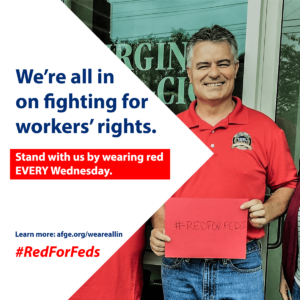
We're all in on fighting for workers' rights. We need you and your coworkers to show management and the administration that our union isn't going anywhere. Make sure to wear red EVERY Wednesday.
When management and the administration see worksites full of government workers wearing red, it will be a powerful display of our strength, solidarity, and willingness to fight the administration's outrageous attempts to bust our union and break our democracy.
It is up to us to keep working for what is right - and to do that, our union has to be all in. That's why we're wearing Red for Feds every Wednesday, and sharing pictures of our red on social media with the hashtag #RedForFeds.
Please make sure that you are not on government time or government property when you take or share your photos. If your employment requires a specific uniform or dress policy, be mindful of compliance. The wearing of red is not for, or against, any candidate or party, and is not a violation of the Hatch Act.
By joining together and raising our voices as a union family, we know we can do great things. Thank you for all that you do.
If you have any questions or would like to talk about more ways you or your local can get involved, don't hesitate to e-mail us at district7@afge.org.
In Solidarity,
Dorothy James
National Vice-President
American Federation of Government Employees
District 7

2nd Wednesday of each Month.
Time: 6:00 p.m.
Location: 600 W. Madison, Chicago IL 60661
Room: HWSSC Conference Room #1- 1st FL.
The Justice Department on Tuesday filed a notice that it would appeal a recent court decision that struck down three controversial workforce executive orders President Trump signed earlier this year to make it easier to fire federal workers and reduce the influence of federal employee unions.
The case will go to the U.S. Court of Appeals for the D.C. Circuit.
In a notice filed in U.S. District Court for the District of Columbia, Assistant Attorney General Joseph Hunt said the administration will seek to overturn the August decision by U.S. District Judge Ketanji Brown Jackson, which found that the key provisions of the executive orders were unlawful.
AFGE FAMILY,
As a union family, we know that we can count on each other for help when we need it the most. And after Hurricane Florence, we know that some of our brothers and sisters may need some extra help as they recover.
FEEA was created in 1986 to financially help government workers with disaster relief and scholarship funds, so that they could provide for their families and pursue their dreams.
AFGE will continue to do everything we can to support our members and get our communities back on their feet. Thank you for all that you do.
In solidarity,
AFGE
P.S. Were you affected by Hurricane Florence, and are you in need of financial assistance? If so, click here to apply for a FEEA grant.
Democracy Wins as Court Strikes Down Trump’s Anti-Worker Executive Order
AFGE applauds ruling that administration illegally gutted workers’ rights, violated labor contracts
WASHINGTON – In a landmark decision, a federal judge has ruled that President Trump violated the U.S. Constitution and laws providing checks and balances in the federal government by attempting to deny more than 2 million federal workers their legal right to representation.
Judge Ketanji Brown Jackson of the U.S. District Court for the District of Columbia ruled late last night that the Trump administration’s May 25executive order on official time violated the 1stAmendment to the U.S. Constitution and the separation of powers as established in law.
The American Federation of Government Employees, which was the first union to challenge President Trump’s executive orders in court, applauded the judge’s ruling.
“President Trump’s illegal action was a direct assault on the legal rights and protections that Congress specifically guaranteed to the public-sector employees across this country who keep our federal government running every single day,” AFGE National President J. David Cox Sr. said.
“We are heartened by the judge’s ruling and by the huge outpouring of support shown to federal workers by lawmakers from both parties, fellow union workers, and compassionate citizens across the country,” Cox said. “Our members go to work every single day to serve the American people, and they deserve all the rights and protections afforded to them by our founding fathers.”
AFGE, the largest union representing federal government employees, filed two lawsuits challenging President Trump’s executive orders. The first lawsuit challenged the executive order on official time as a violation of the right to freedom of association guaranteed by the First Amendment, and as exceeding the president’s authority. The second lawsuit charged that the remaining two orders exceed the president’s authority under the U.S. Constitution by violating the separation of powers and exceeding current law.
The impact of these executive orders began being felt months before they were even issued, as the Department of Education in March threw out the contract covering 3,900 federal employees represented by AFGE and implemented its own illegal management edict that strips workers of their union rights, a precursor to what was to come weeks later when President Trump issued the three union-busting, anti-federal worker executive orders. Since the executive orders were signed May 25, other agencies including the Social Security Administration and Department of Veterans Affairs have issued similar edicts in an attempt to eradicate unions from the federal workplace and deny workers their legal right to representation.
“Now that the judge has issued her decision, I urge all agencies that have attempted to enforce this illegal executive order to restore all previously negotiated contracts and to bargain in good faith with employee representatives on any future changes as required under the law,” Cox said.

